
Children’s Village
In 2005, a 30 acre plot of land was acquired in Mkuranga, a small town 30 miles south of Dar es Salaam, where land was cheap and there was plenty of space for children to play and for crops to grow.
The village was uniquely designed and built in stages. It incorporates family sized dormitories, washrooms, classrooms, a central kitchen, a small library and two large, open sided central halls where everyone eats and where the children can play when the rains happen.
The village was officially opened in July 2010 at a televised ceremony conducted by former President Ali Hassan Mwinyi, attended by over 250 guests. The project has twice won the prestigious ‘Order of Uhuru Torch’ for ground-breaking work for social development in Tanzania.
Currently, the village can accommodate 80 children. They are each in families of up to ten with a resident mother. They eat and sleep as a family, and the mother ensures they are well and do their homework.
One of our mothers is a trained nurse. Our children all have health insurance, and we have a close relationship with Mkuranga hospital. A retired GP based in the UK also gives regular health advice.
Education
The education of the children is a strong focus for us. Ultimately, these children need to find jobs in a difficult job market. Without a normal family network, education and training are key.
If a child comes to us at a very young age, we have a small baby class, where one of the mothers helps them learn to walk, talk and sing a great many songs in English and Swahili.
They then move to an in-house pre-school class, where a fully qualified teacher teaches them to read and write, as well as some words and nursery rhymes in English.
Initially, we sent all our primary school children to the local Mkuranga Primary school. Class sizes there were over 100; they taught almost entirely in Kiswahili; the school struggled to cope with the special needs of children who may have come to schooling relatively late in life.
In 2015, a new primary school called Lifewaylight opened its doors about 100 yards from our own front gate. They teach only in English and keep class sizes down to 30 or less. For a small fee, we find that children who have been there for a few years read, write and speak English quite well. This is an asset for their whole lives, but it particularly helps with secondary education which is mainly taught in English.
The children who come to Malaika Kids can be of various ages. If they are in the later stages of primary education, and they cannot speak English, it is necessary to use the Kiswahili-speaking Mkuranga Primary. We also run remedial classes in the village every day for these children.
Where appropriate, a few children board five days a week at a special needs school that caters to children with severe developmental problems.
At secondary level, we use an academically rigorous boarding school, St Matthew’s, for the children who get strong grades in their final year at primary school. For those less strong, we use Ujenzi secondary school – also boarding, but less strongly academic.
It is becoming more and more necessary for children to acquire a certificate to say they have completed four years of secondary school. In the past, we have tried to by-pass secondary school and sent some children straight to work experience training. We now prefer them to complete four years at Ujenzi first.
After secondary school, some go on to further training such as accountancy or social work. Others will receive some practical training, for example in hairdressing or carpentry. Typically, these courses are available in Dar es Salaam, and the young adults will be based in the Reception Home.
We take the lead in supporting educational initiatives in Tanzania. In order to be able to discuss the children on an individual basis, we undertake annual visits to Tanzania whenever possible.
Outside School
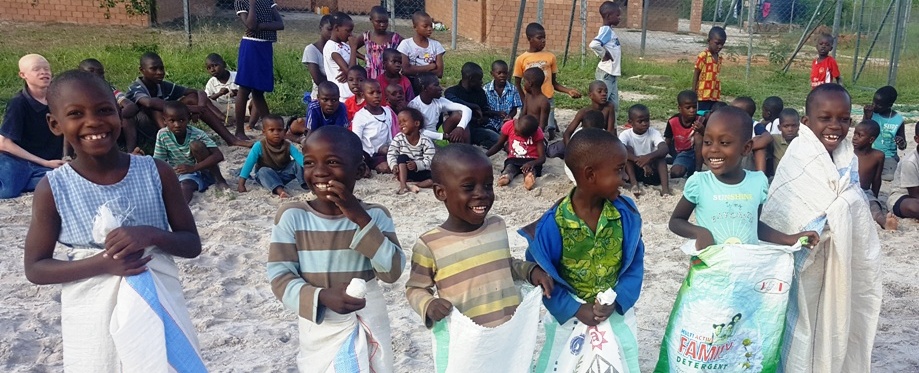
Every day between 5 and 6 pm, all the children and mothers take part in some sort of sporting activity in the grounds. The boys mainly play football (in bare feet), while the girls either play volleyball or netball. The younger children just play as young children do. At this time of day, temperatures are a little cooler, before darkness rapidly arrives and it is time for supper.
There is a small library in the village which the children are encouraged to use. They can watch the evening news on TV after supper. On a Friday night (with no school the next day), a DVD movie is often projected in one of the classrooms.
On a Saturday morning, one of the mothers takes a group of children to learn something on several computers that we were gifted.
During the vacations, the village manager likes to take the children on some form of outing, such as to the zoo, or to a beach.
We celebrate the key Christian and Muslim festivals (both are represented) with special meals and the children enjoy a ‘disco’ later.
Maintenance work and the farm
There is a maintenance programme undertaken every year. A few specialist volunteers from Europe travel to supervise the more complex projects. Over time, more of this work is undertaken locally, as the village manager and his assistant have become more expert.
We try to be sensitive to the environment where we can and utilise solar power for lighting and pumping water.
To help with our farm, we catch rainwater from our tiled roofs and channel water into several large pools. This helps us cultivate land that would not be especially useful outside the rainy season.
The land is very sandy and the soil quality is poor. We have been working with the Royal Agricultural University to devise a plan to make our farm more robust and sustainable and are implementing an Agroforestry system to plant crops between rows of new fruit trees.
We have experimented with a variety of crops. Most have struggled in the extreme heat (now more extreme as Global Warming affects Tanzania) and poor soil, but pineapples have thrived; the surplus crop is sold in the local market. The land produces a variety of green vegetables which contribute to the children’s diet.